Macedonian cuisine
  • Home
  • Tradition
  • Places and events
  • Kitchen hacks
  • Health
  • Privacy Policy
  • Contact Us
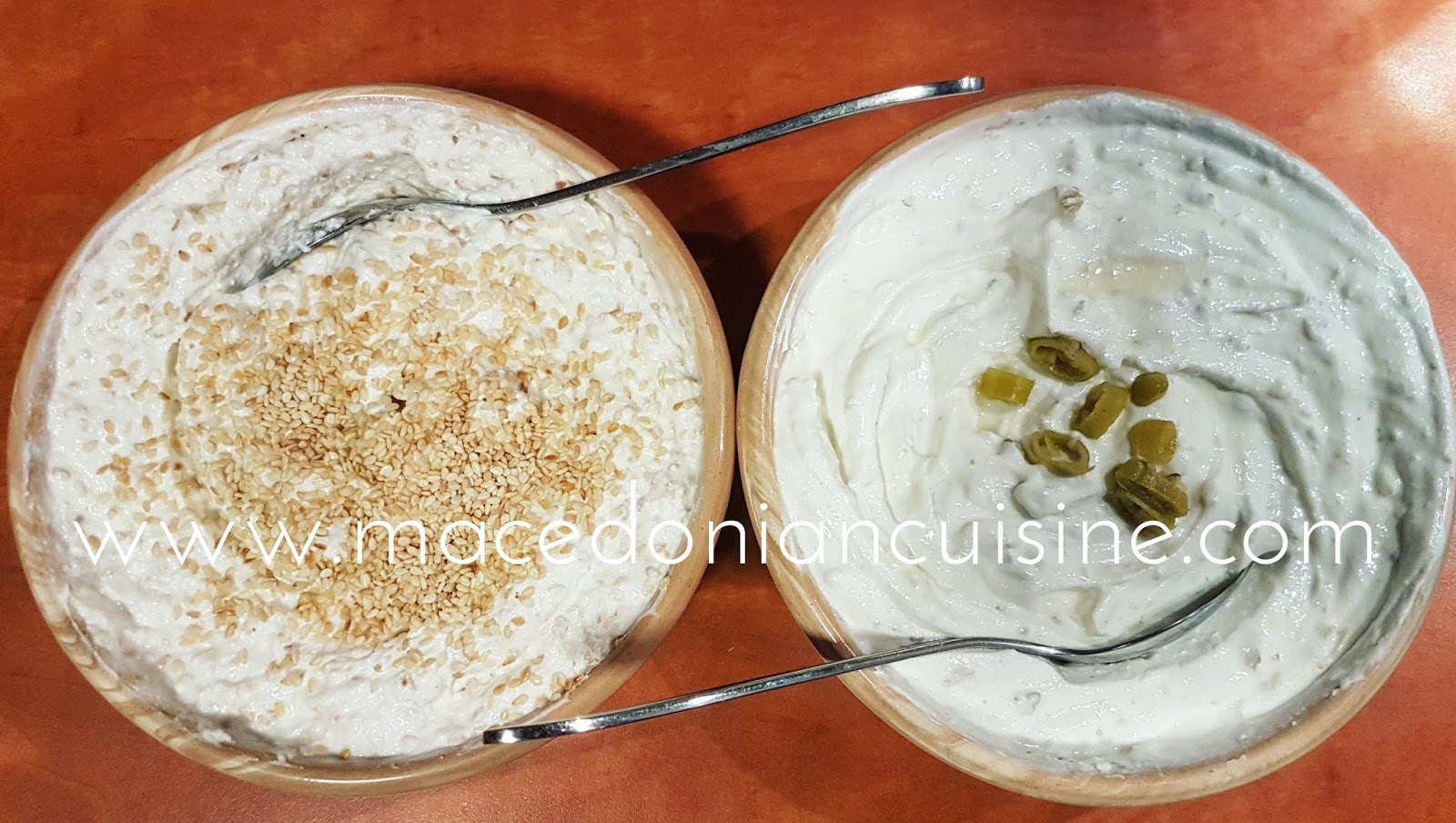
If guests come and you don't have much time to prepare food, these salads are a really great choice in which everyone will enjoy.

They are prepared very quickly and easily,  very tasty and are an excellent addition to kifli and other pastries, as well as rakija or mastika.


For tiro salad

Ingredients:

  • 250 g of feta cheese
  • 400 g of sour cream
  • 5-6 small hot peppers (relish or fresh)
  • 1/2 teaspoon oregano
  • 1/2 teaspoon dry parsley
  • salt

Preparation:
Spread the cheese with a fork, add finely chopped hot peppers, sour cream, oregano and dry parsley and mix well.


For Sesame Salad

Ingredients:


  • 250 g of ricotta cheese
  • 3-4 tablespoons of sour cream
  • 2 tablespoons of mayonnaise
  • 100 g roasted sesame seeds

Preparation:

Roast the sesame seeds on a pan without oil. It will get a wonderful aroma.
Mix the ricotta cheese, sour cream and mayonnaise and add the sesame seeds and mix well.


From this morning, the Christmas fast has begun. Christmas fast is the period preceding Christmas feast. It lasts about 40 days and, according to the church, is also called "Philip's Post", because it starts after November 27th - the day of the memory of the Apostle Philip.

The Orthodox Church wrote that the Christmas fast is established so that believers can purify themselves with repentance, prayer and fasting, and with pure hearts, souls and bodies, in order to meet the Son of God who appeared in the world, offering him, instead of ordinary gifts and sacrifices, the pure heart of the believers and the desire for receiving His teaching.

The rules of restraint, prescribed by the Church in the Christmas fast, are the same as for the St.Peter's post. It is clear that meat, butter, milk, eggs, cheese are avoided at the time of fasting. In addition, the Constitution says that on Monday, Wednesday and Friday in the Christmas fast, no fish, wine and oil are eaten, and only food is allowed without oil.

On other days - Tuesday, Thursday, Saturday and Sunday is a vegetable oil food.

The fish during the Christmas fast is allowed on Saturdays and Sundays, as well as on big holidays, such as the holiday "Introduction to the Temple of the Virgin Mary", and also on churches holidays and the days of the great saints, but only if those holidays fall on Tuesday or Thursday. If the holiday falls on Wednesday or Friday, it is resolved on wine and oil.

From January 2nd to 6th, fasting is intensified and in those days, even on Saturday and Sunday, fish is forbidden according to the church rules.

This is one of the best recipes for chocolate cake I've ever tried in my life. I prepared it for my birthday which was on 17th of November. Beautiful, creamy and juicy with rich chocolate flavor. Amazing! Let's make clear that you can use any chocolate cream you want, so if you choose other than Nutella, choose a good one. Here I used Nutella because it has rich hazelnut taste. It's a simple recipe  and doesn't require many ingredients and much time. Basically, the cooling time is longer than preparation time.


For the biscuit:
  • 4 eggs
  • 8 tablespoons of sugar
  • 4 tablespoons of flour
  • 2 tablespoons of milk
  • 1 tsp baking powder
  • 4 tablespoons Nutella
Syrup for the biscuit:
  • 1 tbs sugar
  • juice of half orange
  • 1 tbs cocoa
  • 100 ml of milk
Filling:
  • 250 ml sweet cooking cream
  • 200 g of dark chocolate
  • orange peel
  • 2 tbs Nutella
Preparation:

  1. First beat the eggs and sugar with a mixer until foamy, then add the remaining ingredients for the biscuit. Pour the mixture in the pan from the oven coated with baking paper and bake at 180 C degrees for about 15 minutes. Leave to cool after baking.
  2. Prepare the filling: put the cooking cream to heat in a pot, add the chocolate and nutella and let it melt and blend everything until smooth. Add some grated orange peel and leave to cool down. I put it in the freezer to harden quicker.
  3. Prepare the syrup by boiling the milk, sugar and cocoa for 5 minutes and add the juice after removed from fire.
  4. Then, take the biscuit and cut it in 3 equal stripes.
  5. Align the first stripe on the cake plate, and pour 1/3rd from the syrup over the biscuit.
  6. Apply little less than 1/3rd from the filling. Then add the 2nd stripe and repeat the procedure. Add the 3rd stripe and repeat again and spread the filling all over the cake.
  7. Decorate as desired, I think it's the best to decorate with hazelnuts.
  8. Put it in the fridge and serve after several hours.
The first time I tried these cookies was last year in Greece, in Lerin, at my Macedonian grandmother for Kolede, they celebrate it on December 23rd. It was a love at first taste. She dropped me several pieces for home and wrote down the recipe. They told me they are making them for Christmas. They melt in the mouth, the taste of cinnamon and honey is really seducing.

Ingredients:
 
For the dough:

  • 1 kg of flour
  • 3 cups oil
  • 1 cup of sugar
  • 1 cup of semolina
  • 1 pack baking powder (10 g)
  • 1/2 cup orange juice
  • 1/2 cup cognac
  • 1 tablespoon honey
  • 1 teaspoon cinnamon

For the syrup:
  • 2 cups of sugar
  • 2 cups of water
  • 2 tablespoons honey
  • 1 stick of cinnamon
  • 3-4 pieces of cloves

Nuts for decoration

Preparation:

  1. First, prepare the syrup. Boil water, sugar with cinnamon and cloves until it begins to thicken. After the pot is removed from fire, add honey and remove the cinnamon and the cloves and leave to cool down completely.
  2. Mix the dough from all the ingredients for the dough and make small balls as the size of a walnut or oval shaped forms. 
  3. Align on an oiled baking pan and bake at 170 C degrees until they are baked, about 20 minutes. 
  4. Pour with the cold syrup while they are hot and decorate with crushed walnuts. 
  5. They are not stored in the fridge but at room temperature covered with nylon foil.

A little different way to prepare pork. A beautiful dish and a great idea for lunch. This dish serves 4 people.


Ingredients:
  • 700 g pork
  • 1 tbs Vegeta
  • 60 g sharp flour
  • 3 tbs oil
  • 1 tbs red sweet paprika
  • 3 boiled eggs
  • 4 small pickles
  • 1 cup water
  • half cup white wine
  • 100 ml tomato paste
  • a punch of curcuma
  • bay leaf
Preparation:

  1. Beat pork using a meat hammer. Cut in pieces, rub with Vegeta then dip each piece in flour.
  2. Fry meat on some oil on both sides. When done, move it aside and put paprika in the same pan and add water, wine, tomato paste and curcuma.
  3. After water and paprika boil, add chopped eggs and pickles.
  4. Return meat in the pan and all together boil for several minutes.
  5. With this dish you can also serve potato or potato croquettes or mashed potatoes.
Combination of chocolate and coconut - perfection! A quick cake that tastes like the famous Bounty chocolates. It's made in no time, no baking, similar to the amazing bayadera cake. It takes around 20-30 minutes to prepare this beautiful dessert.
 
First part:
  • 300 g of biscuits
  • 200 g of dark chocolate
  • 100 ml of milk
Second part:
  • 500 ml of milk
  • 100 g of sugar
  • 80 g of semolina
  • 200 g of coconut shredded flakes
Glaze:
  • 100 g of dark chocolate
  • 100 ml of sweet cooking cream (hopla)
  • 40 g butter
Preparation:
  1. For the first part: Grind biscuits and chocolate (I used a blender). Add the milk and mix, and put the mixture in a rectangular or square pan and press it and equally spread it with your hand.
  2. For the second part: boil milk with the sugar and semolina until they thicken, add 200 g of coconut flakes and mix. This mixture is applied over the first part while it's still hot.
  3. The glaze - ingredients for the glaze are melted on a steam and when the mixture is smooth, it is applied over the second part.
  4. Place the cake in a refrigerator to cool down, then cut into rectangles or cubes.
When you try this recipe, I guarantee you'll make kifli this way in the future. Soft, spongy, mouth melting - you'll love them! I got 2 pans from these ingredients, on the pics you can see only the first dose. I need to mention that making kifli is a something Macedonian women do for ages. My mom made them, my grandma made them, my gran-grandma made them etc. But in the late years, many women stopped making them at home and instead, they are buying them from the bakery. I keep it to the traditional way and make them at home. It takes about 2 hours to make them (including the waiting time).


Ingredients:

FOR YEAST
  • 300 ml warm milk
  • 1 cube of fresh yeast 40 g
  • 1 teaspoon of sugar
  • 2 teaspoons of flour (taken from 1 kg)
FOR DOUGH
  • 1 kg of flour
  • 300 ml of yogurt
  • 2 eggs
  • 150 ml of oil
  • 1 teaspoon of salt
FOR COATING
  • 1 egg yolk
  • sesame seeds
  • margarine or butter as needed
Preparation:
  1. First, the yeast is activated in warm (not hot) milk together with sugar and a little flour.
  2. Once activated, mix it in with other ingredients and knead soft dough. According to these ingredients and quantities, there should be no need for more flour or milk.
  3. The dough covered with a cloth is left to rise in a warm place for 30 minutes.
  4. Then it is divided into 4 balls. Each ball is flattened one at a time in a circular shape with a thickness of about 3-4 mm and cut into 16 triangles (first halfway along the horizontal, and then halfway along the vertical, and all quarters are cut into 4 triangles). The filling is optional. I made them with ricotta. The filling is applied to the wider side and roll in the form of buns.
  5. Ready-made kifli are aligned on a baking pan covered with a baking paper. They are coated with yolk and sprinkled with sesame seeds. Put a small piece of margarine or butter on each.
     
  6. Leave kifli for 20 minutes in the tray, then bake at 180 C degrees for about half an hour. When they start to be baked (about after twenty minutes baking), they are coated with slightly melted margarine/butter and returned in the oven to be completely baked.
I first tried this salad when visiting friends. My friend gave me the recipe after I ate it whole from the table :) She said they call it Indian salad. Why-I don't know. Nevertheless the name, it's a beautiful cocktail salad, especially when u have guests. They'll be impressed, I guarantee!


Ingredients:
  • 200 g of mayonnaise
  • 500 g of boiled and chopped chicken meat
  • 200 g of sour cream
  • 100 g of peanuts
  • 100 g sunflower seeds
  • salt, pepper to taste
  • 1 tablespoon mustard
  • 1 tablespoon curry in powder
  • 3-4 pickles 
Preparation:
  1. Boil the chicken and let it cool down, then cut it into small pieces. Add crushed peanuts and sunflower and mix. Add the chopped pickles.
  2. In another bowl, mix sour cream, mayonnaise, pepper, salt, mustard, and curry. Then mix in all ingredients.
  3. Decorate salad as desired.
  4. Store in a refrigerator.
The main characteristic of the Macedonian costume is the embroidery with luxurious and geometric patterns, srma and braids, as well as jewelry made of metal, silver, beads and fruits of nature. As a characteristic ornament, especially for women's costumes, mostly embroidered were the shirts and headbands. The embroideries were developed and nurtured on the entire territory of Macedonia. The color is dominated by the red color, although green, yellow and dark blue are also present.
A characteristic of the Macedonian embroidery is the densely embroidered surfaces and specific ornaments and motifs. The Macedonian national embroidery clearly testifies the creative originality of its creator - Macedonian woman.


Conveying continuously from generation to generation, according to the essence and belief of the Macedonian people in continuation of traditions, Macedonian embroidery in its development reached the highest achievement in the 19th century. This art, whose roots lie on the Slavic soil, certainly incorporates traces and layers from various past eras and cultures. Its complex evolutionary process began to take place especially after the migration of the Slavs to the Balkans, by adjusting with the related Balkan cultural elements. The Byzantine culture had special significance for the further development and formation of the Macedonian embroidery art. The centuries-old Turkish influence did not significantly affect the development of the Macedonian emblematic creativity further, although some elements of Islamic art are evident, especially in one of the colorful changes and the infiltration of new motives. However, despite the various historical factors, the formation of the Macedonian embroidery creation in an undifferentiated international art is certainly due to the collective artistic potentials of the environment in which it was created and existed.


Bearers of the embroidery creation in Macedonia were exclusively the folk costumes, especially the rural ones, which remained in their entire life function until the first decades of this century. The embroidery was a characteristic traditional ornament, especially for feminine costumes, and most of the embroidered shirts and headgear covers. The feminine shirt had elements of tunic like clothes, typical for all of Macedonia, retained traces of ancient forms, which lead to an interconnected relationship with the old-Balkan ornamented tunic, used in the Balkans even before the arrival of the Slavs, and which was not unknown to the Slavic world. Retaining at the original stages in the development of this cloth, as far as its shape is concerned, the Macedonian shirts have further developed its decoration, reflecting the splendid style of Byzantine textiles.
Among the different female embroidered head tops, a special place belongs to the bridal scarves and they not only stand out as top aesthetics values ​​of Macedonian artificial art, but also have historical significance as the oldest Macedonian embroidered products, so far, in which great archaicity is conserved. Their apparent similarity in form, technique, ornaments and function, with parts of the costumes of some peoples of the Volga area, could not spring up accidentally and of course confirm many longstanding cultural and historical ties.
The Macedonian embroideries were made regularly with domestic woolen laces, which were also facilitated by the once developed Macedonian sheep breeding. Homemade silk was used for embroidery of festive and wedding costumes. Particularly typical was the domestic traditional way of preparing woolen embroidery threads, which were crocheted and doubled only with hands, without any technical aids, which are one of the most important degrees of spinning of textile fibers.
For almost all Macedonian embroidery is mostly characteristic its performance by counting the wires from the canvas, and most often from the bare side, which makes it easier to count, but which requires a developed technical skill. In terms of technical performance, for the Macedonian embroidery the most typical is the Goblen technique - which has reached a high level of technical variation. Separate techniques in embroidery - relief, skilled, cross - are limited to some areas. Embroidery with a straight rifle is the most commonly used for women's headgear, which, due to the highly technical performance, were often made only by individuals.


Colors of embroidery
Macedonian embroidery is usually polychrome, but the knowledge of more tonal gradations of the same colors is a very limited phenomenon. More rarely is present bichromatic embroidery, while monochromatic is a feature of only some regions.
The color of the Macedonian polychromatic embroidery is dominated by the red color in its wide tonal register, but this depends on the region and the chronology of its use.

Wheat is an integral part of the Macedonian tradition and serves in honor of the saint who is celebrated for the health and progress of the home and the family. The wheat grain in Christianity is a symbol of eternal life, death and resurrection. The wheat prepared for slava (saint's glory) is boiled and offered in honor of the saint who is celebrated, for health and progress in the home and the people who live in it, as well as for the rest of the souls of all the ancestors who lived in that home. After cutting the wheat cake, the grain first is served to the host, and then the other members of the family. After that, all the guests are served, and as people come to the slava, are first served with wheat. The wheat is most often served by the housewife or girl from the house, daughter or granddaughter, in the following way: the host offers the wheat to the guest, the guest makes cross, turns to the host and the householder, congratulates the saint's glory and takes from the wheat, after which again crosses and sits in place. The wheat is first served to the elderly, then to the young. The wheat tray stands beside the glory candle while the glory lasts. If wheat remains when the glory is over, it is given to the children or to the present guests.
 
Ingredients:
  • 500 g of wheat
  • 400 g of sugar
  • 400 g of crushed walnuts
  • 1 pack vanilla sugar (10 g)
  • 1 tsp nutmeg
  • 1/2 tsp cinnamon
Preparation:
  1. Clean the wheat and put it in a bowl, then pour it over with water and leave it overnight.
  2. The next morning, wash the soaked wheatn in several waters and cook the wheat in a pot.
  3. When the wheat is cooked, let it cool down a little and when it reaches the room temperature, drain it, but don't wash it so it can keep its wheat starch.
  4. While it's still warm, mince the wheat shortly in a blender, don't mince it too much, just a bit.
  5. Add minced walnuts, sugar, vanilla sugar, cinnamon and nutmeg to taste.
  6. Mix well everything well, then place the resulting mixture in a shallow plate, cover it with nylon foil and shape it with hands. Then, decorate as desired, add powdered sugar on top or crushed walnuts. Make cross in the middle.
I first tried pasta with pesto last year when I was on a trip in Rome. Believe it or not, that was my first time trying pesto. I'm not very fond of basil so pesto was something that was invisible for me. Was! After trying pesto, I realized my silliness. And I won't be me if I don't try to make something at home instead of buying it. So I made pesto at home. The hardest thing might be finding the Pecorino cheese. If you can't find it, double the dose of the Parmesan.


Ingredients for 4 persons:
  • 500 g Pasta Spaghetti
  • 10-20 g butter
For pesto genovese:
  • 30-40 g of fresh basil
  • 40 g of pine nuts (pinon)
  • 40 g of grated Pecorino cheese
  • 40 g of grated Parmesan cheese
  • 3 cloves of garlic
  • 100 ml of olive oil
  • salt
Preparation:

  1. Boil spaghetti in boiled water and drain.
  2. Leave a little water (about 100 ml in which pasta was cooked) to the side.
  3. Place the sliced ​​basil, pine nuts, grated cheese, sliced ​​garlic and about 50 ml of olive oil in the electric blender. Mix the mixture, then add the remaining oil, salt and mix all together.
  4. Put the prepared pesto in a porcelain bowl.
  5. In a large pan, melt the butter, add 2-3 tablespoons of pesto and mix together briefly.
  6. Add boiled spaghetti and a little water in which the pasta was cooking.
  7. Mix well spaghetti and warm.
  8. Serve spaghetti hot, and if desired, you can add a parmesan on top.
  9. You can prepare the Pesto Genovese in a larger amount. It can stand for about 2 weeks refrigerated.
There are many recipes for crepes, I've tried many of them, all of them work for me. I usually make crepes with the available ingredients I have in my kitchen, like the last time, I didn't use eggs cause I didn't have any :) I use milk when I have one, if I don't, I add yogurt or sour milk or just a sprinkling water. Every variation is good. This one includes boiling water. I've noticed that the boiling water made them even softer.


Ingredients:
  • 1 egg
  • 150 g of flour
  • 1/3 teaspoon of baking soda
  • 1/2 cup of boiling water
  • 1 cup of sour milk
  • 1/3 teaspoon salt
  • 1 tablespoon oil
Preparation:
  1. Mix the egg well, add the sour milk, oil, salt, sugar and flour with continuous stirring. A smooth mixture should be obtained.
  2. Continue to stir and add baking soda previously dissolved in boiling water. The mixture should now be with medium density.
  3. Allow to stand for five minutes, then start baking pancakes on a heated pan with a non-sticky bottom, which you have oiled with a butter or oil. Oil the pan on every crepe or every second crepe.
  4. Note: When bubbles appear on one side of the crepe, it is time to turn to the other side and bake evenly.
  5. Good appetite!
Popara is something that definitely reminds me of my grandmother. She always made me popara when I stayed at her place, sometimes for breakfast, sometimes for dinner. Grandma's popara was the best! I can't remember if I ate popara again after my grandma passed away. Probably not.
I did't eat my popara with sugar, my grandma put me chocolate powder on top instead. And because she was a diabetic, she didn't put any sugar in her popara.
In that time, the milk she used was brought by a farmer, 2 or 3 times a week. She kept these 3 wide neck glass bottles specially for milk, and she exchanged the empty ones for full. The taste of the milk today can never compete with the milk I drank when I was a child.

So, to make popara is quite easy. Warm some milk in a coffee pot, break 2 or 3 pieces of bread in a dip plate and pour over the warm milk. Add some sugar or chocolate powder on top. Wait 1-2 minutes so the bread can soak the milk.

Newer Posts Older Posts Home

MENU

  • Desserts
  • Main dish
  • Tradition
  • Knead food
  • Health
  • Salads
  • Beverages
  • Kitchen
  • Places
  • Relish
  • Soups
  • Salads for cocktails
  • Jams

POPULAR RECIPES

  • Karaman Officially Recognized as an Authentic Macedonian Dog Breed
  • STUFFED PEPPERS (PIPERKI POLNETI)
  • HOW TO MAKE MAZNIK-STEP BY STEP
  • PASHA MEATBALL (PASHA KJOFTE)
  • POTATO STEW (KOMPIR MANDZA)
  • MACEDONIAN MOUSSAKA WITH POTATOES AND MINCED MEAT (MUSAKA)
  • SARMA (PICKLED CABBAGE ROLLS WITH MINCED MEAT AND RICE)
  • 5 TRADITIONAL FASTING DESSERTS
  • TURLITAVA (TRADITIONAL VEGETABLE DISH)
  • 14TH OF FEBRUARY-THE DAY OF ST.TRYPHON

Search This Blog

Powered by Blogger

ABOUT ME

"Eight years ago, I embarked on a mission to share the rich flavors, culture, history and heritage of Macedonia with the world." - Gordana

Support my shop

HTML

Contact Us

Name

Email *

Message *

Follow us on facebook

Facebook

Copyright © Macedonian cuisine.